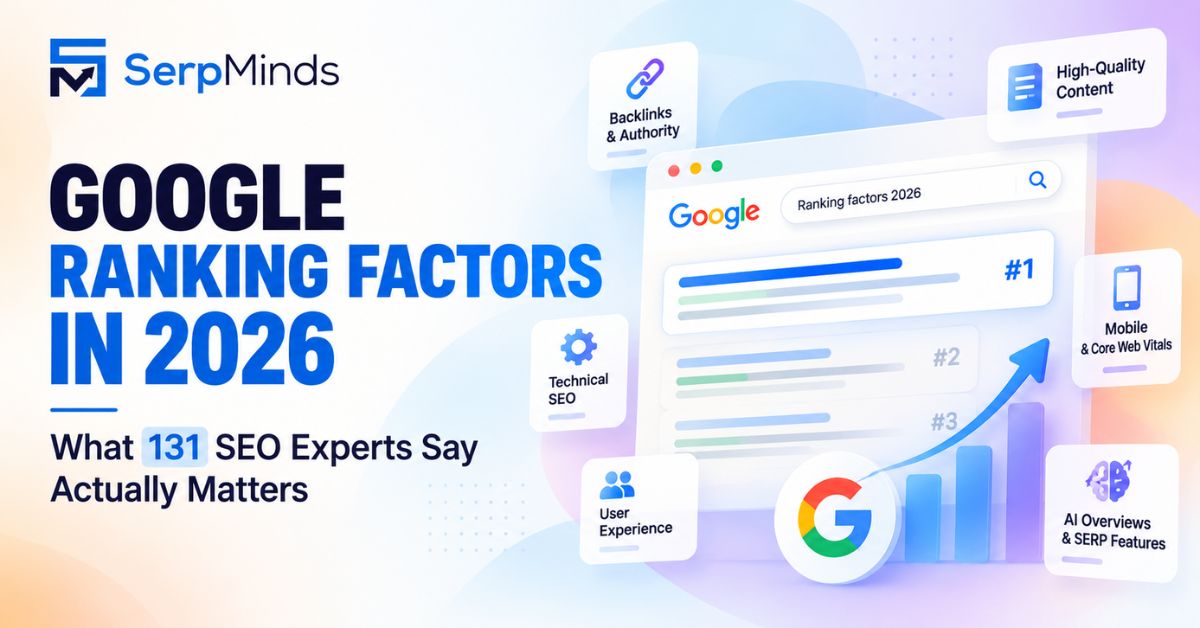
Google Ranking Factors in 2026: What 131 SEO Experts Say Actually Matters
Every couple of years, someone asks the SEO industry to stop guessing out loud and actually put numbers on the table. This year it was Cyrus Shepard and Dawn Shepard, who published
Every couple of years, someone asks the SEO industry to stop guessing out loud and actually put numbers on the table. This year it was Cyrus Shepard and Dawn Shepard, who published the Google Ranking Factors Expert Survey 2026 on September 9 through Zyppy Signal the first survey of its kind since the Google API leaks and the DOJ antitrust trial handed the industry actual internal evidence to argue over.
They pulled in 131 practitioners. Not junior link builders guessing on forums people like Aleyda Solis, Dr. Pete Meyers, Lily Ray, Kevin Indig, Koray Tugberk Gubur, Barry Schwartz, and around 125 others who run agencies, build tools, or consult for sites doing real revenue. Collectively, they scored more than 100 possible ranking factors and generated 13,665 data points. That’s not a listicle’s worth of opinion. That’s the closest thing the outside world has to a consensus read on what Google actually rewards right now.
Here’s why this particular survey matters more than the usual “top 10 ranking factors” blog post: it landed at the exact moment organic search stopped being a reliable traffic source for a lot of sites. AI Overviews are now cutting the top organic result’s clicks by roughly a third, and a controlled experiment in mid-2026 found they suppress outbound clicks by close to 40% while pushing zero-click searches up by a similar margin. So when 131 experts tell you what still moves the needle, they’re really telling you what’s worth fighting for in a search results page that increasingly doesn’t send anyone anywhere.
AI Overviews click impact: top organic result loses 34.5% of clicks, outbound clicks cut 39.8% in a randomised experiment, zero-click searches up 34.5%, organic CTR down 61% across 42 organisations
Let’s break down what they actually said, and what it means if you’re running SEO for a SaaS product, an EdTech platform, or an ecommerce catalog in 2026.
How the survey was actually built
Survey methodology: 131 experts, 103 ranking factors, 13,665 data points, published September 9, 2026
Before the numbers, it’s worth understanding the method, because it changes how you should read the percentages below.
Each of the 131 respondents scored over 100 factors on a 7-point scale from +3 (strongly positive) to -3 (strongly negative). Then, separately, they answered an open-ended question: “What are the three most important Google ranking factors?” with no list to choose from they had to write it themselves.
The percentages you’ll see below come from that second question. They represent how many experts independently named a factor in their personal top three, not a measured weight inside Google’s algorithm. Nobody outside Google knows the actual weights. What this survey gives you is something almost as useful: where 131 people who watch rankings move for a living, day after day, agree the leverage actually sits.
The top 10, ranked
Top 10 Google ranking factors 2026, ranked by percentage of experts naming them a top-3 factor
The top 10, ranked
|
Rank |
Factor |
% who named it top-3 |
|
1 |
Relevance |
57.1% |
|
2 |
Backlinks |
54.8% |
|
3 |
Content Quality |
47.6% |
|
4 |
Authority & Trust |
36.5% |
|
5 |
Behavior / Click Signals |
29.4% |
|
6 |
Brand Signals |
27.0% |
|
7 |
User Satisfaction |
19.8% |
|
8 |
Technical SEO Health |
17.5% |
|
9 |
Topical Authority |
14.3% |
|
10 |
Internal Links |
11.1% |
Two things jump out immediately. First, the top three haven’t really moved from what serious SEOs have argued for years relevance, links, quality. Second, look at what’s missing from the top 10 entirely: meta descriptions, keyword density, exact page titles, most of the checklist that dominates beginner SEO content. The panel didn’t rate those things negatively so much as irrelevant to the conversation about what actually decides a ranking.
Here’s the quick version of why each one made the cut, before we go deeper into any single factor:
1. Relevance. 57.1%
Why it matters: This is the only factor that can’t be faked with effort elsewhere. Perfect technical SEO and a pile of backlinks won’t save a page that answers the wrong question, the panel rated search intent match higher than all 102 other signals tested.
2. Backlinks. 54.8%
Why it matters: The “links are dead” narrative is wrong, but the bar for what counts as a good link moved up. A link only helps if it sits on a page with a real audience, link volume without traffic is now closer to noise than signal.
3. Content Quality. 47.6%
Why it matters: AI has made publishing free, which means quality is now the only thing standing between your page and a thousand near-identical competitors. Original research and first-party data are what the panel says actually separates a page from a rewrite of a rewrite.
4. Authority & Trust. 36.5%
Why it matters: This is Google’s shortcut for deciding who to believe when it can’t verify a claim itself — it’s the accumulated reputation of your site, your authors, and your brand across the web, not something you build in a single content sprint.
5. Behavior / Click Signals. 29.4%
Why it matters: Court testimony and the 2024 API leak gave the industry hard evidence that systems like Navboost use real click data to adjust rankings. This jumped in importance this year specifically because it’s no longer speculation.
6. Brand Signals. 27.0%
Why it matters: Several contributors argued this is underweighted even at 27%. Branded search volume works as a trust shortcut for Google, and it’s also the one ranking asset that survives fully intact when a searcher never clicks through at all.
7. User Satisfaction. 19.8%
Why it matters: Google’s real target metric isn’t rankings, it’s task completion. A page can rank and still get quietly demoted over time if too many visitors bounce back to the results page looking for a better answer.
8. Technical SEO Health. 17.5%
Why it matters: The panel’s near-unanimous framing: technical SEO is a floor, not a ladder. It won’t win you the ranking, but a broken one (bad canonicals, blocked crawling, slow indexing) will actively cost you one.
9. Topical Authority. 14.3%
Why it matters: Google increasingly ranks sites, not just pages, for how completely they cover a subject. One good article on a topic you never return to is worth less than a body of connected content Google can point to as expertise.
10. Internal Links. 11.1%
Why it matters: It finished last by vote share but drew some of the warmest individual comments in the whole survey- mainly because it’s the one ranking lever you fully control. No outreach, no algorithm luck, just architecture you can fix this week.
Now let’s go one level deeper into each area, because the “why” behind these numbers is where the actual strategy lives.
1. Relevance: search intent beat everything else tested
Out of all 103 individual factors the survey measured not just the grouped categories above one single signal scored higher than every other: Search Intent Match, defined as how well a page satisfies the type of result or task the searcher actually wants.
This is a sharper standard than “use the keyword in your H1.” Matching intent means your page has to be the thing the searcher was hoping to click on, not just talk about it. Andy Chadwick, one of the contributors, put it as an information-gain problem: once ten pages all satisfy the same intent, what separates them is whether one page adds something the others don’t.
The panel’s take on Melissa Popp’s contribution captures the whole section in one line she said you can have technically flawless content with perfect headings and a clean URL, and none of it matters if you answered the wrong question.
One genuinely surprising data point buried in this section: exact-match domains are apparently still punching above their weight. Shai Aharony noted ranking an EMD for a competitive term with a fraction of the effort his main site needed for the same query a tactic most of the industry assumed Google neutralized a decade ago.
And the factor rated so weak that most respondents gave it zero impact? The meta description. Google has said this publicly for years it only affects the snippet you see, not the ranking but it’s notable that 131 working practitioners now agree strongly enough that it barely registered.
2. Backlinks: not dead, just more selective
Backlinks came in at #2, and the panel’s framing directly contradicts the “links don’t matter anymore” narrative that’s floated around content marketing circles for a few years now. Links from trusted, topically relevant domains scored among the highest of any individual factor in the entire survey.
The distinction that mattered to the panel wasn’t quantity, it was whether a link sits on a page real people actually visit. Nitin Manchanda’s comment sums up the shift: a hundred links from real audiences beat a thousand links nobody ever clicks.
There’s also a newer wrinkle worth paying attention to if you’re thinking beyond classic Google rankings: Andrew Shotland described a client mentioned and linked in a Reuters article whose visibility inside ChatGPT reportedly jumped 4x within a week. Whether or not that generalizes, it signals something practitioners are starting to track closely links from authoritative publications may now be doing double duty, feeding both classic search rankings and AI citation systems at once.
On the flip side, spam links were rated as one of the most negative factors in the whole study, despite Google’s own public stance that it mostly just ignores low-quality links rather than penalizing for them. Whether that’s fear built from old Penguin-era trauma or genuine current signal, the panel isn’t taking chances with cheap link building.
3. Content quality: the filter against AI content flooding the web
This is where 2026’s results genuinely diverge from earlier ranking factor surveys. Original research and first-party data topped this category not word count, not “comprehensiveness,” not any of the older proxies for quality.
The logic, as Ross Simmonds framed it, is straightforward: AI has made content production essentially free, so the cost of publishing has collapsed to zero while the cost of earning trust has gone up. When anyone can generate a thousand articles overnight, the sites that actually did the work ran the survey, pulled the first-party data, tested the thing separate themselves by default.
Importantly, the panel wasn’t universally down on AI-assisted content. Abby Gleason reported strong results from AI-generated content at scale on a site that also had substantial unique and user-generated content, where every AI draft went through serious human editorial review before publishing. The objection isn’t to AI as a tool. It’s to AI content published at scale with nothing added.
There’s also a genuine tightrope here that Gianluca Fiorelli named directly: lean too far toward consensus and you’re invisible for adding nothing new; push too hard toward novel information gain and you risk reading as needlessly contrarian. The sweet spot is narrower than most content calendars account for.
4. Brand & reputation: the signal that survives zero-click search
Brand signals ranked lower on the “top 3” list (27%) but generated some of the strongest opinions in the entire survey: several contributors argued it’s underrated relative to its actual weight.
Branded search volume: how many people search for your business by name and online reputation were the two standout factors here. Jan-Willem Bobbink went as far as calling brand the single strongest factor in his own experience, arguing a site can get away with rough technical execution and unremarkable content as long as people are actively searching for and talking about the brand. Roger Montti traced the idea back to a Google patent, framing branded search as functionally “the new link” since 2012.
Dan Petrovic’s comment is worth sitting with if you’re chasing “expert-level” content as a strategy: he suggested content that’s too advanced can actually hurt visibility, because Google ultimately rewards what gets talked about and shared broadly not necessarily what’s most technically rigorous.
Google Ad Spend, for what it’s worth, showed only a barely positive influence, and the panel’s consensus was that any lift is indirect ads drive visibility and branded search, which then feed the signals above, rather than paid spend having any direct ranking effect of its own.
5. User & click signals: the antitrust trial changed how the industry thinks
This category jumped significantly compared to older surveys, and the reason is specific: the 2024 Google Content Warehouse leak and DOJ antitrust testimony gave the industry hard evidence that a system called Navboost uses click data to influence rankings something SEOs had suspected for years but couldn’t previously prove.
Satisfaction / task completion rated highest in this group, while return-to-SERP when a searcher clicks your result, doesn’t find what they want, and goes straight back to Google rated as a clear negative. AJ Kohn’s comment reflects how seriously practitioners are now taking this: he argues sites should build their own satisfaction metrics by page type, because there’s a real ranking ceiling once your click signals trail the competition sitting above you in the results.
Gerry White drew a useful distinction here too bounce rate alone is a weak, noisy metric, but pogo-sticking specifically (bouncing back to the SERP and clicking a different result) is a much cleaner signal that something on your page failed the visitor.
6–8. Technical SEO, internal links, and UX: necessary, not sufficient
The panel was almost unanimous that technical SEO is table stakes Marshall Simmonds called it a commodity that won’t win you the race but can absolutely lose it for you. Bad technical health tanks otherwise good content; good technical health doesn’t elevate mediocre content on its own. Dana DiTomaso’s example is a good illustration of the downside risk: a client’s canonical tags were accidentally pointed at unrelated pages, and fixing that single issue produced a roughly 60% jump in impressions and clicks almost immediately.
Internal links finished last in the top-10 list by vote share (11.1%) but got some of the warmest individual comments. Fili Wiese called internal linking the one ranking lever a site controls completely end-to-end, it decides which pages accumulate authority and how Google reads the relationships between your topics. If backlinks are outside your control, internal architecture is the lever you can actually pull today.
Core Web Vitals and site speed produced the most disagreement of any factor in the whole survey. Ryan Jones called speed and CWV “the most overrated things in SEO,” arguing the real cutoff is binary either the page loads fast enough or it doesn’t. Greg Gifford pushed back directly, noting that for large ecommerce sites, speed genuinely does move revenue, while a local business site can get away with slower load times because user expectations are different by category. Read: the correct answer depends heavily on your vertical, not a universal rule.
What this actually means if you run SaaS, EdTech, or ecommerce SEO
The survey is industry-agnostic by design, but the translation looks different depending on what you’re optimizing. A few practical takeaways by vertical:
SaaS and B2B: Branded search and reputation carry more weight than most SaaS SEO roadmaps assume. If your PR, comparison-page, and review-site strategy isn’t feeding branded search volume, you’re underinvesting in the category the panel rated as the most durable against AI Overviews eating your click-through rate. Original research usage data, benchmark reports, product data nobody else has — now does more for you than another “best tools for X” listicle.
EdTech (where I spend most of my own time): Search intent match is brutal in this category because exam-prep and course queries carry very specific, very literal intent “IPMAT eligibility criteria,” “IPMAT 2026 exam pattern.” A page that half-answers that intent and pivots into a course pitch gets punished on satisfaction signals fast. First-party data actual student results, actual interview process breakdowns, actual cutoffs — beats generic exam content every time, and it’s exactly the kind of original research the panel says Google is now filtering for.
Ecommerce: This is the one vertical where the panel’s “technical SEO is table stakes, not a lever” framing needs a caveat site speed genuinely correlates with conversion and revenue at scale here, so the usual advice to deprioritize Core Web Vitals doesn’t fully apply. But the bigger opportunity sits in internal linking and category architecture, which most ecommerce sites still treat as an afterthought despite it being one of the few ranking levers fully within your control.
The bottom line
If you strip out the noise, 2026’s ranking factors read less like a new SEO playbook and more like a return to a harder standard: actually satisfy the person who searched, actually earn attention from real audiences and real publications, and actually produce something nobody else has. None of that is new advice. What’s new is the confidence 131 people who watch rankings for a living, backed by leaked internal documentation and courtroom testimony, now agree on it in specific, measurable terms.
The checklist-driven version of SEO perfect meta descriptions, exact keyword density, technical audits as the whole strategy isn’t wrong, exactly. It’s just no longer where the leverage is. The leverage is in relevance, real trust, and content that couldn’t have been generated by anyone else’s prompt.
Survey data and expert commentary referenced throughout are from the Google Ranking Factors Expert Survey 2026 by Cyrus Shepard and Dawn Shepard, published via Zyppy Signal on September 9, 2026.
Mohit Rajora
Want this working on your site?
Book a free consultation and we'll map the fastest path to growth.
Book a free session